Employment Tax
United States | Convenience of the Employer and nonresident business traveler updates
Summary
Alabama recently released guidance reversing the Department’s position on a COVID-19 era Tax Tribunal ruling that effectively created a Convenience of the Employer (“COE”) rule through administrative interpretation. The ruling imposed Alabama state income tax on “Alabama sourced income” for the nonresident working remotely outside of the State for an Alabama employer.
Other states continue to enforce the COE rule, and tax authorities have increased audit and enforcement activity at both the employee and employer levels. However, legislation was recently introduced at the federal level that, if enacted, would effectively eliminate the COE rule and establish a more uniform framework for state income tax sourcing. Additionally, states continue to update their nonresident withholding tax thresholds for business travelers.
The detail
Alabama reverses course on COE
On August 25, 2026, the Alabama Department of Revenue (“the Department”) issued a notice stating that an employer should withhold Alabama income tax from wages paid to a nonresident employee only to the extent the wages are attributable to services physically performed in Alabama. If a nonresident employee performs no services in Alabama during the year, Alabama income tax withholding is not required solely because the employer is located in Alabama.
This guidance reverses the 2023 Tax Tribunal decision (Mark E. Bollinger v. State of Ala. Dep’t of Rev., Inc. 22-390-LP (Ala. Tax Tribunal, 3/8/23)) that upheld the Department’s assessment of income tax on the wages that a remote worker earned from his Alabama employer while working from his home office in Idaho. The notice explicitly states, “The Department will not follow the Alabama Tax Tribunal’s ruling in Bollinger v. State of Alabama Department of Revenue…to the extent that ruling is inconsistent with this Notice.”
COE in other states and potential federal relief
There are currently 6 states and 1 municipality that enforce a COE rule: New York, Pennsylvania, Philadelphia, Nebraska, Delaware, New Jersey and Connecticut. New Jersey and Connecticut’s COE rules are only applicable to nonresidents whose resident state has a COE rule. Tax authorities have increased audit and enforcement activity of the COE rule at both the employee and employer level. One taxpayer has made numerous attempts to challenge New York on its enforcement of the COE rule during the COVID-19 pandemic, so far unsuccessfully and has filed his latest appeal against the State’s COE assertion on July 20, 2026 (Zelinsky v. Tax Appeals Tribunal (No. CV-25-1156)).
However, relief could potentially be on the horizon. On August 24, 2026, representatives from Connecticut, New Jersey, and New Hampshire introduced the Multi-State Worker Tax Fairness Act. The bill would establish a uniform standard for taxing income based on physical presence in a state. In doing so, the bill prohibits a state from taxing a nonresident’s income earned when the individual was not physically in that state. If passed, this bill could have a significant impact on the jurisdictions that currently enforce a COE rule.
Nonresident business travelers
States continue to revise their nonresident withholding tax rules.
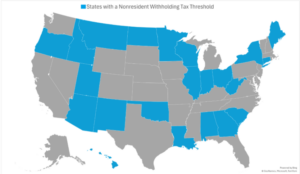
States are continuing to update their nonresident withholding tax thresholds. Most recently, Alabama enacted a 30-day safe harbor rule for business travelers (Act 2025-334), with certain criteria for exemption. This change reflects a broader trend among states to adopt or expand de minimis withholding thresholds that delay employer withholding obligations until an employee exceeds a specified number of workdays or earnings within the state.
States that currently provide a withholding tax threshold based on days worked or compensation earned are highlighted in blue below.
How we can help
Companies with employees working across multiple jurisdictions, including remote and hybrid workers, should develop tracking mechanisms and establish policies for monitoring and maintaining employee work locations to ensure compliance with multi-state withholding and reporting requirements. Given the continual changes in state nonresident withholding thresholds, employers should also monitor legislative developments and assess their impact on state payroll tax compliance. Vialto can assist with understanding multi-state withholding tax exposure, developing a nonresident withholding policy, and designing and implementing effective tracking and compliance solutions.
Contact us
For a deeper discussion on the above, please reach out to your Vialto Partners point of contact, or alternatively:
Tina Schrob
Partner
Jessica Castro
Director
Jake Webb
Director
Want to know when a regional alert is posted?
Simply follow our Vialto Alerts page on LinkedIn and posts will be displayed on your feed. To ensure you don’t miss one, once you’re on our LinkedIn page, click on the bell icon under the banner image to manage your notifications.
Further information on Vialto can be found here: www.vialtopartners.com
Vialto Partners (“Vialto”) refers to wholly owned subsidiaries of CD&R Galaxy UK OpCo Limited as well as the other members of the Vialto Partners global network. The information contained in this document is for general guidance on matters of interest only. Vialto is not responsible for any errors or omissions, or for the results obtained from the use of this information. All information is provided “as is”, with no guarantee of completeness, accuracy, timeliness or of the results obtained from the use of this information, and without warranty of any kind, express or implied, including, but not limited to warranties of performance, merchantability and fitness for a particular purpose. In no event will Vialto, its related entities, or the agents or employees thereof be liable to you or anyone else for any decision made or action taken in reliance on the information in this document or for any consequential, special or similar damages, even if advised of the possibility of such damages.
© 2026 Vialto Partners. All rights reserved.